Voice of the People — The Voice of the Masses, a Reflection of Reality
।। 101 ।। The Politics of Distrust and Distrust in Politics: The World Is Gasping for Breath

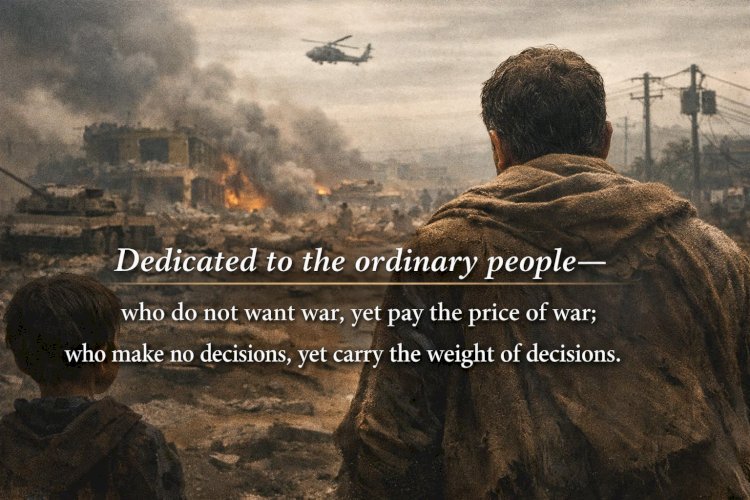
Dedication
“To those ordinary people—who do not want war, yet pay its price; who do not make decisions, yet bear the burden of those decisions.”
The twenty-one-hour meeting in Islamabad has ended. There were papers, pens, and diplomatic language on the table—but the most essential element was missing: trust. The outcome was therefore predictable—no agreement was reached, only statements were issued; no solution emerged, only a competition of blame-shifting. In the language of international relations analysts, this is now called a “managed crisis”—a new strategy of prolonging a crisis while keeping it under control.
This is precisely where the greatest crisis of today’s global politics lies. On one hand, politics is being conducted by capitalizing on distrust; on the other, people’s trust in politicians is steadily collapsing. Recent surveys (such as reports from various international think tanks) show that in many countries, a large portion of the population believes their governments conceal the truth or tell only partial truths. Caught in the middle of this dual crisis are ordinary people—for whom policy, diplomacy, and ceasefires ultimately remain nothing more than newspaper headlines.
The United States says it has made its “red lines” clear. Iran says it will not retreat “even an inch” from its rights. Between these two statements lies the entire story. One side’s security infringes upon the other’s sovereignty; one side’s demand is perceived by the other as humiliation. As a result, even when they sit at the negotiation table, it is as if they are speaking two entirely different languages. History shows that when the 2015 nuclear deal (JCPOA) was reached, this crisis of trust had not been fully resolved; it had merely been temporarily suspended. Its eventual collapse made it clear once again—no agreement can endure without trust.
This raises a question—who are these negotiations really for? For state leaders, or for the people? If they were truly for the people, would they collapse so easily? Was twenty-one hours too little time to build a bridge of trust? Or was the will to build that bridge simply absent? The reality is that, often, the goal of such discussions is not resolution, but legitimization of positions—demonstrating strength to their respective domestic audiences.
The language of world leaders has become all too familiar. They speak of “peace,” yet prepare for war; they speak of “stability,” yet engage in power plays; they speak of “human rights,” yet prioritize their own interests. In recent years, global military spending has reached historic highs—proving that preparations are far more aggressive than the rhetoric. This duplicity has become so visible that it can no longer be called diplomacy—it is a form of political performance.
Tensions in the Strait of Hormuz, conflict in Lebanon, information control in Iran—together they form a picture that is not merely a regional crisis, but a reflection of global instability. Nearly one-fifth of the world’s energy supply depends on the Strait of Hormuz. As a result, even minor tensions there drive up global energy prices, directly affecting places from London to Dhaka. In other words, a regional conflict no longer remains regional; it becomes a risk to the global economy.
World leaders often say, “The problem is complex.” But the reality is, they themselves play a role in making it complex. When every decision is weighed in terms of political gain and loss, peace can never come through a straightforward path. Instead, it becomes an excuse for prolonged negotiations—where time passes, but solutions do not emerge. This prolonged diplomacy is often intentional because uncertainty extends power.
In such a situation, what do ordinary people feel? They do not want war, sanctions, or energy crises. They want a normal life—secure jobs, stable markets, and a certain future. But their aspirations become very small at the grand table of global politics. As a result, their suffocation grows—economically, in terms of security, and mentally. The middle class loses purchasing power, the poor struggle to survive, and uncertainty breeds despair within society.
It now seems that world leaders are less capable of solving problems and more skilled at sustaining them. Because once problems are solved, the need for negotiations disappears, influence diminishes, and opportunities for control become limited. Perhaps that is why the doors to dialogue remain open, but the exit remains invisible—trapping everyone within a “continuing crisis.”
So, what is the way forward?
The solution is not very complex, but it is difficult. First, the politics of trust must be restored—where agreements are established not only on paper, but in minds. Second, real human conditions must be prioritized beyond interests—where the life of an ordinary person is seen not as a statistic, but as a reality. Third, instead of displays of power, there must be a practice of responsibility—where leadership means not control, but resolution.
But the question remains—will that exist?
The failed meeting in Islamabad has brought that question back to the forefront. Those twenty-one hours were not wasted; rather, they revealed a harsh truth—global politics has reached a point where suspicion is more powerful than words.
And it is the ordinary people of the world who carry the burden of that suspicion—silently, every day, little by little.
Author: Editor, Columnist, Analyst, and Former Professor
London, 12 April