Claims, Denials, and a Fragile Truce: Middle East Tensions Simmer Beneath Surface Calm

Voice of People | International Desk
The Middle East finds itself at a delicate crossroads—where bold political claims clash with hard realities on the ground, and a fragile ceasefire struggles to hold amid deep-rooted tensions.
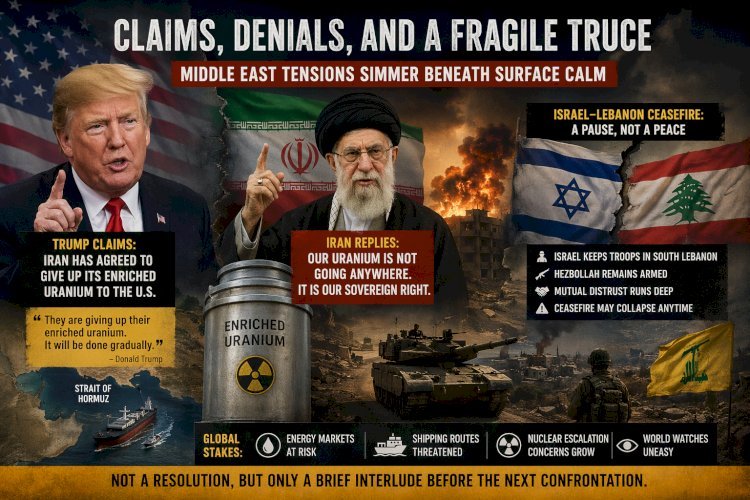
Former U.S. President Donald Trump has stirred fresh controversy by claiming that Iran has agreed to hand over its enriched uranium to the United States. According to him, the transfer would happen gradually, marking what he described as a major step toward regional stability.
However, Tehran has firmly rejected these assertions.
Iranian officials insist that their enriched uranium is a matter of national sovereignty and will remain within the country. For years, Iran has maintained that its nuclear programme is intended for peaceful purposes, and any suggestion of surrendering its nuclear assets is categorically unacceptable.
This sharp contradiction highlights a familiar pattern in U.S.-Iran relations—public narratives that diverge significantly from diplomatic realities.
A Ceasefire Under Strain
At the same time, a 10-day ceasefire between Israel and the Iran-backed group Hezbollah has entered its early phase in Lebanon. While the pause in fighting has brought temporary relief to civilians, the situation remains highly volatile.
Israeli Prime Minister Benjamin Netanyahu has made it clear that military operations are not over. Israeli forces continue to maintain positions in parts of southern Lebanon, and officials have warned that operations could resume if threats persist.
Despite U.S. claims of restraining Israeli actions, conflicting signals from Tel Aviv suggest that the ceasefire may be more tactical than transformative.
Why the Truce May Not Hold
Analysts point to several reasons why the current ceasefire is unlikely to last:
- Core issues remain unresolved: Hezbollah’s military capabilities and Israel’s security concerns are still intact.
- Deep mistrust persists: Iran, Israel, and the U.S. continue to operate with profound suspicion toward one another.
- Military readiness continues: A pause in combat does not mean a halt in preparation.
- Domestic political pressure: Within Israel, there is significant support for continuing military operations.
Global Stakes
Beyond the region, the implications are far-reaching. Rising tensions have already impacted global energy markets and shipping routes, particularly around the strategic Strait of Hormuz.
The uranium dispute adds another layer of risk, raising concerns about nuclear escalation at a time when stability is already fragile.
The Bottom Line
For now, the Middle East stands in a state of uneasy pause—
peace in statements, uncertainty in reality.
Trump’s claims, Iran’s defiance, and a shaky ceasefire all point to one conclusion:
This is not a resolution, but perhaps only a brief interlude before the next phase of confrontation.